Not a question, but a common observation from our customers is their surprise at the performance of the EFIS. Thanks for the many e-mails complimenting us on our work so far. Why would I want a Dual AHRS for my Horizon system? At first glance the benefits of a Dual AHRS EFIS may not be obvious. The benefits become more apparent when the redundancy is combined with the automation provided by the EFIS. • Automatic cross-check. This is by far the biggest advantage, as this reduces the pilot's need to constantly manually cross-check the various sources of attitude data in the airplane. The GRT EFIS is continuously compares the two AHRS solutions, and will alert the pilot when a significant disagreement occurs. • Flying with a Failed AHRS - EFIS operation remains practically unchanged with one AHRS failed in the Dual AHRS installation. The pilot continues to use the EFIS, retain all of its functionality, and fly the airplane as he is accustomed. Without the dual AHRS, the pilot must fly using the backup instruments, something he has much less experience with, and which requires greater pilot workload. • Dispatch Reliability - Lose an AHRS? Don't worry about canceling your trip, or having to scramble to find replacements in the middle of you trip. You always have a spare. The redundancy means losing one AHRS has no functional loss for VFR flights. With a single AHRS, all primary flight functions are lost, often requiring immediate maintenance. • Simpler Backup Instruments - Backup instruments are used only to determine which AHRS has failed in the unlikely event of an undetected AHRS failure, and are not required as the primary reference for continued flight. Simpler and lower-cost backup instruments easily meet this requirement, such as a turn and bank indicator. • Redundant Pitot/Static, Magnetometer, and Power - Each AHRS has its source, making the EFIS tolerant of the loss of external systems. A pitot clogged by a bug, or a single broken wire will not stop this EFIS. • Enhanced Airplane Value - In addition to all the benefits above, the Dual AHRS is an asset that increases the value of the airplane, bringing a VFR airplane a big step closer to IFR capable for the current or future owner of the airplane. Am I able to connect a Horizon display and a Sport display using the Display Unit Link? No. The Display Unit Link is only between like GRT EFIS, for example up to two Sport displays or Horizon displays only. The Display Unit Link is not provided for a Sport and a Horizon display system. Why was the overall size chosen for the WS? The overall size of the WS display is such that two will fit, stacked on top of each other, in the RV and similar panels. This allows a great deal of flexibility, yet is still large enough to be easily readable. The HS display was chosen for it greater size to allow more split pages. Why not save the cost of the magnetometer, and make this optional? Without a magnetometer, GPS data is required for calculation of attitude. Bad or loss of GPS data would cause unexpected loss of attitude data, and would reduce the integrity of the attitude data, and would reduce the performance of the GPS/AHRS cross-check. Also, the magnetometer provides the magnetic direction indication data required for VFR and IFR flight. Why not build the EIS into the EFIS for its engine monitoring functions? The EIS provides a full time, easy-to-read display of engine data. This makes a single EFIS display unit completely practical. Without the EIS, a second EFIS display would be required to allow full time display of engine data. Engine monitoring requires numerous connections to the engine and its sensors. Each of these connections is exposed to high levels of electrical noise, and has the potential of electrical faults introducing unexpected voltages to them. Bringing signals of this type into the EFIS has the potential for adversely affecting the EFIS, and thus reducing its integrity. The EIS provides a convenient backup for altitude and airspeed data if desired. Why not use mechanical instruments? Of course you still have that option, but the GRT EFIS is similar in price, does not have display representations limited by mechanical movements, does not require periodic maintenance, and includes automatic cross-checking of its data. Clearly the days are numbered for mechanical gyros, and in fact they no longer exist in many commercial and military aircraft. Can I really see it in direct sunlight? Absolutely. How did you solve the technical issues with an AHRS, when your main background appears to be engine instrumentation? The mathematical algorithms we use are based on proven, accepted techniques developed by the aerospace industry. Our AHRS project leader is an electrical engineer, with over 20 years of aerospace experience. Ten years of this experience was with Boeing, and Smiths Industries, working with inertial navigation (a more advanced version of AHRS). What are the limitations of the AHRS? When flying close to the magnetic north or south poles, the AHRS must revert to using GPS track data, instead of magnetic heading data. This reduces the integrity of the AHRS calculation of attitude, and the effectiveness of its GPS/AHRS cross-check. The EFIS will alert the pilot to this degraded mode of operation. Obviously, this is unlikely to affect most users. In theory, it is possible for the AHRS to be affected by vibration, especially if resonances (flexibility) exists in the mounting of the EFIS to the airplane. A simple flight test is performed to check for this possibility. We have not seen this problem occur in our testing, but in theory, it is possible. The maximum angular rates are 200 degrees/second in roll, pitch, and yaw simultaneously. What backup instruments are recommended for a single GRT EFIS installation? For VFR flight, the addition of an airspeed is suggested. For IFR flight a turn coordinator, airspeed indicator, and altimeter is a minimum, but the pilot should consider their flying skills when configuring their cockpit. For dual electrical bus installations, the EIS can be equipped to serve as a backup airspeed indicator, and altimeter.. This has the added benefit of automatic cross-checking against the EFIS Horizon's airspeed and altitude. Why is the MAP database free for US customers? Our database is based on U.S. government data, provided to us at no charge therefore we provide it at no charge. Will a database be available for airspace outside of the United States? Yes. We will be providing nav data from Jeppesen for our international customers. Currently, the database outside of the US only includes airports with runways of 3000 feet or greater. Can I use a low-cost handheld GPS with the EFIS Horizon? Yes. Even low-cost GPS receivers include the required NMEA 0183 output. Are the units user selectable? Yes. Practically all data may be displayed in your choice of units, including the barometric pressure setting, temperatures, fuel quantity, etc. What is the most important feature of the GRT EFIS? Our high integrity AHRS is not GPS nor pitot-static dependent for attitude solution. Does the EFIS have a "Quick Erect" function? No. The only reason to have such a function is if the attitude information was to sometimes become corrupted. The attitude data provided by our system is of very high integrity, and there is no need for a "quick-erect" function. Note that even if the airplane is continuously performing turns and/or aerobatics, the attitude data will remain accurate. What happens if the AHRS is turned off in flight? It would be unusual to turn off the AHRS in flight, as it is the primary source of attitude data. If it is turned off, the airplane must be flown as steady as possible for the first 10 seconds after power is re-applied. The plane can then be flown in any manner, and the AHRS will begin providing attitude data within a minute or two. Why are autopilot servos available with the EFIS? Originally we approached this subject with the very conservative recommendation to always use an external autopilot to gain the benefit of its independence from the EFIS, and the inherent (although not automatic) cross-check the two independent systems provide. While there is nothing wrong with this approach, we have recently changed our opinion on this subject. Our AHRS has accumulated several hundred thousand hours, and exhibited extremely high reliability. This high level of confidence diminished the benefit of an independent autopilot. Further, our experience with external autopilots did include some failures, and other issues, that eroded its benefit as an independent source. Adding to this is the common use of our dual AHRS, and often dual or multiple display units, which not only included the redundancy previously provided by an independent autopilot/AHRS combination, but added to this continuous automatic cross-checks, the ability to ability of the second AHRS to show its data on the display units (the attitude data calculated within the external autopilots could not be displayed on the EFIS display units), greater reliability compared with an autopilot, and the elimination of some transients that sometimes occurred when the independent autopilot was coupled to the EFIS. Finally, VFR pilots do not have the requirement for as much redundancy, especially given the excellent reliability exhibited by even a single version of our AHRS. As a result, we now fully endorse the use of our EFIS without an external, independent autopilot, in IFR or VFR flight. For IFR flight, we recommend a dual AHRS. Not only does the addition of a second AHRS and servos cost significantly less (almost half) than an independent autopilot, it also provides the benefit of a second attitude source for the EFIS. For VFR flight, only the servos are required providing an outstanding cost savings. What is your policy on revisions to the software? Software updates are available at no cost and may be downloaded from our website. Can non-TSO instruments be approved for IFR flight in an experimental aircraft? Yes. May I use my 430W to fly WAAS approaches? Yes, using the ARINC 429 module. What are the advantages of including the ARINC 429 interface? Other than reduced wiring for ILS LOC/GS indications? ARINC 429 is required for vertical steering commands to the autopilot and using the capablities of the 430/530 and 480 map/com. How often does the EFIS update the GPS map? Our displays are gyro-stabilized, so our map moves smoothly when you turn, no matter how slowly or quickly your GPS updates. Our screens update at high rates, so everything appears smooth on our screens...no jerks or jumps. This makes a significant difference when rolling out to capture a new ground track on the moving maps, as you don't have to guess or anticipate what the map will look like at the next 1 second update. Is the HITS offset on the screen because you are crabbed for wind? Yes, exactly. It "grows" up and out of the runway, which is obviously a ground-based reference. The primary flight display is shown in "Heading Up" mode, which is the preferred mode, as this makes the veiw on the EFIS match the veiw out the window. Thus, the difference between the heading up centered display, and the ground-based runway guidance is the crab angle. This means that the approach is flown by maneuvering the airplane so that the flight path marker (which represents your path through space) is centered in the HITS. Even without the flight path marker displayed, interpreting the HITS is very natural, as it is identical to the visual clues you use when you look out the window and fly the airplane to the runway in the presence of a cross-wind. You instinctively develop a sense of the direction of travel of the airplane through space when you look out the window, and the flight path marker is a precise indication of this point. The flight path marker is commonly used on head-up displays in fighter aircraft. If so, what happens if the wind is stronger - does the HITS go off screen? It would, except that we apply "display limiting". This means alter the position of all ground based symbology to keep the HITS and runway on the screen. What is the sight picture if you are doing a circling approach or a close in base leg? You see the HITS as though it was a tunnel projected up from the ground. The HITS will not appear on the screen if it is out of view, unless it is out of view due to a strong-cross wind. We will be adding guidance to bring you to the top of the HITS so that we guide you to the vicinity of the airport, and then provide steering to get you to top of the HITS. This is not trivial however. Do you have any plans to incorporate other land data such as bodies of water, terrorial boundaries, roads, etc.? We are currently working on adding more map details to include bodies of water and state boundaries. Can I interface the to the S-Tec Autopilot? Yes, although the S-Tec Nav coupler is required. The cost of this coupler is a significant, especially when compared with the cost and performance of the Tru-Trak line of autopilots. Do I need a nav head with the Garmin 430/530 when using the EFIS? No. Using our ARINC-429 module the EFIS provides the functions of a seperate NAV head.
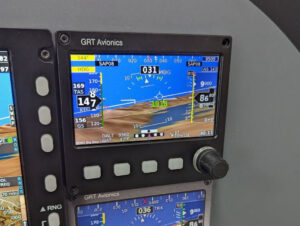
Not a question, but a common observation from our customers is their surprise at the performance of the EFIS. Thanks for the many e-mails complimenting us on our work so far.
Why would I want a Dual AHRS for my Horizon system? At first glance the benefits of a Dual AHRS EFIS may not be obvious. The benefits become more apparent when the redundancy is combined with the automation provided by the EFIS. • Automatic cross-check. This is by far the biggest advantage, as this reduces the pilot's need to constantly manually cross-check the various sources of attitude data in the airplane. The GRT EFIS is continuously compares the two AHRS solutions, and will alert the pilot when a significant disagreement occurs. • Flying with a Failed AHRS - EFIS operation remains practically unchanged with one AHRS failed in the Dual AHRS installation. The pilot continues to use the EFIS, retain all of its functionality, and fly the airplane as he is accustomed. Without the dual AHRS, the pilot must fly using the backup instruments, something he has much less experience with, and which requires greater pilot workload. • Dispatch Reliability - Lose an AHRS? Don't worry about canceling your trip, or having to scramble to find replacements in the middle of you trip. You always have a spare. The redundancy means losing one AHRS has no functional loss for VFR flights. With a single AHRS, all primary flight functions are lost, often requiring immediate maintenance. • Simpler Backup Instruments - Backup instruments are used only to determine which AHRS has failed in the unlikely event of an undetected AHRS failure, and are not required as the primary reference for continued flight. Simpler and lower-cost backup instruments easily meet this requirement, such as a turn and bank indicator. • Redundant Pitot/Static, Magnetometer, and Power - Each AHRS has its source, making the EFIS tolerant of the loss of external systems. A pitot clogged by a bug, or a single broken wire will not stop this EFIS. • Enhanced Airplane Value - In addition to all the benefits above, the Dual AHRS is an asset that increases the value of the airplane, bringing a VFR airplane a big step closer to IFR capable for the current or future owner of the airplane. Am I able to connect a Horizon display and a Sport display using the Display Unit Link? No. The Display Unit Link is only between like GRT EFIS, for example up to two Sport displays or Horizon displays only. The Display Unit Link is not provided for a Sport and a Horizon display system. Why was the overall size chosen for the WS? The overall size of the WS display is such that two will fit, stacked on top of each other, in the RV and similar panels. This allows a great deal of flexibility, yet is still large enough to be easily readable. The HS display was chosen for it greater size to allow more split pages. Why not save the cost of the magnetometer, and make this optional? Without a magnetometer, GPS data is required for calculation of attitude. Bad or loss of GPS data would cause unexpected loss of attitude data, and would reduce the integrity of the attitude data, and would reduce the performance of the GPS/AHRS cross-check. Also, the magnetometer provides the magnetic direction indication data required for VFR and IFR flight. Why not build the EIS into the EFIS for its engine monitoring functions? The EIS provides a full time, easy-to-read display of engine data. This makes a single EFIS display unit completely practical. Without the EIS, a second EFIS display would be required to allow full time display of engine data. Engine monitoring requires numerous connections to the engine and its sensors. Each of these connections is exposed to high levels of electrical noise, and has the potential of electrical faults introducing unexpected voltages to them. Bringing signals of this type into the EFIS has the potential for adversely affecting the EFIS, and thus reducing its integrity. The EIS provides a convenient backup for altitude and airspeed data if desired. Why not use mechanical instruments? Of course you still have that option, but the GRT EFIS is similar in price, does not have display representations limited by mechanical movements, does not require periodic maintenance, and includes automatic cross-checking of its data. Clearly the days are numbered for mechanical gyros, and in fact they no longer exist in many commercial and military aircraft. Can I really see it in direct sunlight? Absolutely. How did you solve the technical issues with an AHRS, when your main background appears to be engine instrumentation? The mathematical algorithms we use are based on proven, accepted techniques developed by the aerospace industry. Our AHRS project leader is an electrical engineer, with over 20 years of aerospace experience. Ten years of this experience was with Boeing, and Smiths Industries, working with inertial navigation (a more advanced version of AHRS). What are the limitations of the AHRS? When flying close to the magnetic north or south poles, the AHRS must revert to using GPS track data, instead of magnetic heading data. This reduces the integrity of the AHRS calculation of attitude, and the effectiveness of its GPS/AHRS cross-check. The EFIS will alert the pilot to this degraded mode of operation. Obviously, this is unlikely to affect most users. In theory, it is possible for the AHRS to be affected by vibration, especially if resonances (flexibility) exists in the mounting of the EFIS to the airplane. A simple flight test is performed to check for this possibility. We have not seen this problem occur in our testing, but in theory, it is possible. The maximum angular rates are 200 degrees/second in roll, pitch, and yaw simultaneously. What backup instruments are recommended for a single GRT EFIS installation? For VFR flight, the addition of an airspeed is suggested. For IFR flight a turn coordinator, airspeed indicator, and altimeter is a minimum, but the pilot should consider their flying skills when configuring their cockpit. For dual electrical bus installations, the EIS can be equipped to serve as a backup airspeed indicator, and altimeter.. This has the added benefit of automatic cross-checking against the EFIS Horizon's airspeed and altitude.
Why would I want a Dual AHRS for my Horizon system?
At first glance the benefits of a Dual AHRS EFIS may not be obvious. The benefits become more apparent when the redundancy is combined with the automation provided by the EFIS. • Automatic cross-check. This is by far the biggest advantage, as this reduces the pilot's need to constantly manually cross-check the various sources of attitude data in the airplane. The GRT EFIS is continuously compares the two AHRS solutions, and will alert the pilot when a significant disagreement occurs. • Flying with a Failed AHRS - EFIS operation remains practically unchanged with one AHRS failed in the Dual AHRS installation. The pilot continues to use the EFIS, retain all of its functionality, and fly the airplane as he is accustomed. Without the dual AHRS, the pilot must fly using the backup instruments, something he has much less experience with, and which requires greater pilot workload. • Dispatch Reliability - Lose an AHRS? Don't worry about canceling your trip, or having to scramble to find replacements in the middle of you trip. You always have a spare. The redundancy means losing one AHRS has no functional loss for VFR flights. With a single AHRS, all primary flight functions are lost, often requiring immediate maintenance. • Simpler Backup Instruments - Backup instruments are used only to determine which AHRS has failed in the unlikely event of an undetected AHRS failure, and are not required as the primary reference for continued flight. Simpler and lower-cost backup instruments easily meet this requirement, such as a turn and bank indicator. • Redundant Pitot/Static, Magnetometer, and Power - Each AHRS has its source, making the EFIS tolerant of the loss of external systems. A pitot clogged by a bug, or a single broken wire will not stop this EFIS. • Enhanced Airplane Value - In addition to all the benefits above, the Dual AHRS is an asset that increases the value of the airplane, bringing a VFR airplane a big step closer to IFR capable for the current or future owner of the airplane.
At first glance the benefits of a Dual AHRS EFIS may not be obvious. The benefits become more apparent when the redundancy is combined with the automation provided by the EFIS.
• Automatic cross-check. This is by far the biggest advantage, as this reduces the pilot's need to constantly manually cross-check the various sources of attitude data in the airplane. The GRT EFIS is continuously compares the two AHRS solutions, and will alert the pilot when a significant disagreement occurs. • Flying with a Failed AHRS - EFIS operation remains practically unchanged with one AHRS failed in the Dual AHRS installation. The pilot continues to use the EFIS, retain all of its functionality, and fly the airplane as he is accustomed. Without the dual AHRS, the pilot must fly using the backup instruments, something he has much less experience with, and which requires greater pilot workload. • Dispatch Reliability - Lose an AHRS? Don't worry about canceling your trip, or having to scramble to find replacements in the middle of you trip. You always have a spare. The redundancy means losing one AHRS has no functional loss for VFR flights. With a single AHRS, all primary flight functions are lost, often requiring immediate maintenance. • Simpler Backup Instruments - Backup instruments are used only to determine which AHRS has failed in the unlikely event of an undetected AHRS failure, and are not required as the primary reference for continued flight. Simpler and lower-cost backup instruments easily meet this requirement, such as a turn and bank indicator. • Redundant Pitot/Static, Magnetometer, and Power - Each AHRS has its source, making the EFIS tolerant of the loss of external systems. A pitot clogged by a bug, or a single broken wire will not stop this EFIS. • Enhanced Airplane Value - In addition to all the benefits above, the Dual AHRS is an asset that increases the value of the airplane, bringing a VFR airplane a big step closer to IFR capable for the current or future owner of the airplane.
No. The Display Unit Link is only between like GRT EFIS, for example up to two Sport displays or Horizon displays only. The Display Unit Link is not provided for a Sport and a Horizon display system.
The overall size of the WS display is such that two will fit, stacked on top of each other, in the RV and similar panels. This allows a great deal of flexibility, yet is still large enough to be easily readable. The HS display was chosen for it greater size to allow more split pages.
Without a magnetometer, GPS data is required for calculation of attitude. Bad or loss of GPS data would cause unexpected loss of attitude data, and would reduce the integrity of the attitude data, and would reduce the performance of the GPS/AHRS cross-check. Also, the magnetometer provides the magnetic direction indication data required for VFR and IFR flight.
The EIS provides a full time, easy-to-read display of engine data. This makes a single EFIS display unit completely practical. Without the EIS, a second EFIS display would be required to allow full time display of engine data. Engine monitoring requires numerous connections to the engine and its sensors. Each of these connections is exposed to high levels of electrical noise, and has the potential of electrical faults introducing unexpected voltages to them. Bringing signals of this type into the EFIS has the potential for adversely affecting the EFIS, and thus reducing its integrity. The EIS provides a convenient backup for altitude and airspeed data if desired.
The EIS provides a full time, easy-to-read display of engine data. This makes a single EFIS display unit completely practical. Without the EIS, a second EFIS display would be required to allow full time display of engine data.
Engine monitoring requires numerous connections to the engine and its sensors. Each of these connections is exposed to high levels of electrical noise, and has the potential of electrical faults introducing unexpected voltages to them. Bringing signals of this type into the EFIS has the potential for adversely affecting the EFIS, and thus reducing its integrity. The EIS provides a convenient backup for altitude and airspeed data if desired.
Of course you still have that option, but the GRT EFIS is similar in price, does not have display representations limited by mechanical movements, does not require periodic maintenance, and includes automatic cross-checking of its data. Clearly the days are numbered for mechanical gyros, and in fact they no longer exist in many commercial and military aircraft.
Absolutely.
The mathematical algorithms we use are based on proven, accepted techniques developed by the aerospace industry. Our AHRS project leader is an electrical engineer, with over 20 years of aerospace experience. Ten years of this experience was with Boeing, and Smiths Industries, working with inertial navigation (a more advanced version of AHRS).
When flying close to the magnetic north or south poles, the AHRS must revert to using GPS track data, instead of magnetic heading data. This reduces the integrity of the AHRS calculation of attitude, and the effectiveness of its GPS/AHRS cross-check. The EFIS will alert the pilot to this degraded mode of operation. Obviously, this is unlikely to affect most users. In theory, it is possible for the AHRS to be affected by vibration, especially if resonances (flexibility) exists in the mounting of the EFIS to the airplane. A simple flight test is performed to check for this possibility. We have not seen this problem occur in our testing, but in theory, it is possible. The maximum angular rates are 200 degrees/second in roll, pitch, and yaw simultaneously.
When flying close to the magnetic north or south poles, the AHRS must revert to using GPS track data, instead of magnetic heading data. This reduces the integrity of the AHRS calculation of attitude, and the effectiveness of its GPS/AHRS cross-check. The EFIS will alert the pilot to this degraded mode of operation. Obviously, this is unlikely to affect most users.
In theory, it is possible for the AHRS to be affected by vibration, especially if resonances (flexibility) exists in the mounting of the EFIS to the airplane. A simple flight test is performed to check for this possibility. We have not seen this problem occur in our testing, but in theory, it is possible.
The maximum angular rates are 200 degrees/second in roll, pitch, and yaw simultaneously.
For VFR flight, the addition of an airspeed is suggested. For IFR flight a turn coordinator, airspeed indicator, and altimeter is a minimum, but the pilot should consider their flying skills when configuring their cockpit. For dual electrical bus installations, the EIS can be equipped to serve as a backup airspeed indicator, and altimeter.. This has the added benefit of automatic cross-checking against the EFIS Horizon's airspeed and altitude.
For VFR flight, the addition of an airspeed is suggested.
For IFR flight a turn coordinator, airspeed indicator, and altimeter is a minimum, but the pilot should consider their flying skills when configuring their cockpit. For dual electrical bus installations, the EIS can be equipped to serve as a backup airspeed indicator, and altimeter.. This has the added benefit of automatic cross-checking against the EFIS Horizon's airspeed and altitude.
Why is the MAP database free for US customers?
Our database is based on U.S. government data, provided to us at no charge therefore we provide it at no charge. Will a database be available for airspace outside of the United States? Yes. We will be providing nav data from Jeppesen for our international customers. Currently, the database outside of the US only includes airports with runways of 3000 feet or greater.
Our database is based on U.S. government data, provided to us at no charge therefore we provide it at no charge.
Yes. We will be providing nav data from Jeppesen for our international customers. Currently, the database outside of the US only includes airports with runways of 3000 feet or greater.
Can I use a low-cost handheld GPS with the EFIS Horizon?
Yes. Even low-cost GPS receivers include the required NMEA 0183 output. Are the units user selectable? Yes. Practically all data may be displayed in your choice of units, including the barometric pressure setting, temperatures, fuel quantity, etc. What is the most important feature of the GRT EFIS? Our high integrity AHRS is not GPS nor pitot-static dependent for attitude solution. Does the EFIS have a "Quick Erect" function? No. The only reason to have such a function is if the attitude information was to sometimes become corrupted. The attitude data provided by our system is of very high integrity, and there is no need for a "quick-erect" function. Note that even if the airplane is continuously performing turns and/or aerobatics, the attitude data will remain accurate. What happens if the AHRS is turned off in flight? It would be unusual to turn off the AHRS in flight, as it is the primary source of attitude data. If it is turned off, the airplane must be flown as steady as possible for the first 10 seconds after power is re-applied. The plane can then be flown in any manner, and the AHRS will begin providing attitude data within a minute or two. Why are autopilot servos available with the EFIS? Originally we approached this subject with the very conservative recommendation to always use an external autopilot to gain the benefit of its independence from the EFIS, and the inherent (although not automatic) cross-check the two independent systems provide. While there is nothing wrong with this approach, we have recently changed our opinion on this subject. Our AHRS has accumulated several hundred thousand hours, and exhibited extremely high reliability. This high level of confidence diminished the benefit of an independent autopilot. Further, our experience with external autopilots did include some failures, and other issues, that eroded its benefit as an independent source. Adding to this is the common use of our dual AHRS, and often dual or multiple display units, which not only included the redundancy previously provided by an independent autopilot/AHRS combination, but added to this continuous automatic cross-checks, the ability to ability of the second AHRS to show its data on the display units (the attitude data calculated within the external autopilots could not be displayed on the EFIS display units), greater reliability compared with an autopilot, and the elimination of some transients that sometimes occurred when the independent autopilot was coupled to the EFIS. Finally, VFR pilots do not have the requirement for as much redundancy, especially given the excellent reliability exhibited by even a single version of our AHRS. As a result, we now fully endorse the use of our EFIS without an external, independent autopilot, in IFR or VFR flight. For IFR flight, we recommend a dual AHRS. Not only does the addition of a second AHRS and servos cost significantly less (almost half) than an independent autopilot, it also provides the benefit of a second attitude source for the EFIS. For VFR flight, only the servos are required providing an outstanding cost savings. What is your policy on revisions to the software?
Yes. Even low-cost GPS receivers include the required NMEA 0183 output.
Yes. Practically all data may be displayed in your choice of units, including the barometric pressure setting, temperatures, fuel quantity, etc.
Our high integrity AHRS is not GPS nor pitot-static dependent for attitude solution.
No. The only reason to have such a function is if the attitude information was to sometimes become corrupted. The attitude data provided by our system is of very high integrity, and there is no need for a "quick-erect" function. Note that even if the airplane is continuously performing turns and/or aerobatics, the attitude data will remain accurate.
It would be unusual to turn off the AHRS in flight, as it is the primary source of attitude data. If it is turned off, the airplane must be flown as steady as possible for the first 10 seconds after power is re-applied. The plane can then be flown in any manner, and the AHRS will begin providing attitude data within a minute or two.
Originally we approached this subject with the very conservative recommendation to always use an external autopilot to gain the benefit of its independence from the EFIS, and the inherent (although not automatic) cross-check the two independent systems provide. While there is nothing wrong with this approach, we have recently changed our opinion on this subject. Our AHRS has accumulated several hundred thousand hours, and exhibited extremely high reliability. This high level of confidence diminished the benefit of an independent autopilot. Further, our experience with external autopilots did include some failures, and other issues, that eroded its benefit as an independent source. Adding to this is the common use of our dual AHRS, and often dual or multiple display units, which not only included the redundancy previously provided by an independent autopilot/AHRS combination, but added to this continuous automatic cross-checks, the ability to ability of the second AHRS to show its data on the display units (the attitude data calculated within the external autopilots could not be displayed on the EFIS display units), greater reliability compared with an autopilot, and the elimination of some transients that sometimes occurred when the independent autopilot was coupled to the EFIS. Finally, VFR pilots do not have the requirement for as much redundancy, especially given the excellent reliability exhibited by even a single version of our AHRS. As a result, we now fully endorse the use of our EFIS without an external, independent autopilot, in IFR or VFR flight. For IFR flight, we recommend a dual AHRS. Not only does the addition of a second AHRS and servos cost significantly less (almost half) than an independent autopilot, it also provides the benefit of a second attitude source for the EFIS. For VFR flight, only the servos are required providing an outstanding cost savings.
Originally we approached this subject with the very conservative recommendation to always use an external autopilot to gain the benefit of its independence from the EFIS, and the inherent (although not automatic) cross-check the two independent systems provide. While there is nothing wrong with this approach, we have recently changed our opinion on this subject.
Our AHRS has accumulated several hundred thousand hours, and exhibited extremely high reliability. This high level of confidence diminished the benefit of an independent autopilot. Further, our experience with external autopilots did include some failures, and other issues, that eroded its benefit as an independent source.
Adding to this is the common use of our dual AHRS, and often dual or multiple display units, which not only included the redundancy previously provided by an independent autopilot/AHRS combination, but added to this continuous automatic cross-checks, the ability to ability of the second AHRS to show its data on the display units (the attitude data calculated within the external autopilots could not be displayed on the EFIS display units), greater reliability compared with an autopilot, and the elimination of some transients that sometimes occurred when the independent autopilot was coupled to the EFIS.
Finally, VFR pilots do not have the requirement for as much redundancy, especially given the excellent reliability exhibited by even a single version of our AHRS.
As a result, we now fully endorse the use of our EFIS without an external, independent autopilot, in IFR or VFR flight.
For IFR flight, we recommend a dual AHRS. Not only does the addition of a second AHRS and servos cost significantly less (almost half) than an independent autopilot, it also provides the benefit of a second attitude source for the EFIS.
For VFR flight, only the servos are required providing an outstanding cost savings.
Software updates are available at no cost and may be downloaded from our website. Can non-TSO instruments be approved for IFR flight in an experimental aircraft? Yes. May I use my 430W to fly WAAS approaches? Yes, using the ARINC 429 module. What are the advantages of including the ARINC 429 interface? Other than reduced wiring for ILS LOC/GS indications? ARINC 429 is required for vertical steering commands to the autopilot and using the capablities of the 430/530 and 480 map/com. How often does the EFIS update the GPS map? Our displays are gyro-stabilized, so our map moves smoothly when you turn, no matter how slowly or quickly your GPS updates. Our screens update at high rates, so everything appears smooth on our screens...no jerks or jumps. This makes a significant difference when rolling out to capture a new ground track on the moving maps, as you don't have to guess or anticipate what the map will look like at the next 1 second update. Is the HITS offset on the screen because you are crabbed for wind? Yes, exactly. It "grows" up and out of the runway, which is obviously a ground-based reference. The primary flight display is shown in "Heading Up" mode, which is the preferred mode, as this makes the veiw on the EFIS match the veiw out the window. Thus, the difference between the heading up centered display, and the ground-based runway guidance is the crab angle. This means that the approach is flown by maneuvering the airplane so that the flight path marker (which represents your path through space) is centered in the HITS. Even without the flight path marker displayed, interpreting the HITS is very natural, as it is identical to the visual clues you use when you look out the window and fly the airplane to the runway in the presence of a cross-wind. You instinctively develop a sense of the direction of travel of the airplane through space when you look out the window, and the flight path marker is a precise indication of this point. The flight path marker is commonly used on head-up displays in fighter aircraft. If so, what happens if the wind is stronger - does the HITS go off screen? It would, except that we apply "display limiting". This means alter the position of all ground based symbology to keep the HITS and runway on the screen. What is the sight picture if you are doing a circling approach or a close in base leg? You see the HITS as though it was a tunnel projected up from the ground. The HITS will not appear on the screen if it is out of view, unless it is out of view due to a strong-cross wind. We will be adding guidance to bring you to the top of the HITS so that we guide you to the vicinity of the airport, and then provide steering to get you to top of the HITS. This is not trivial however. Do you have any plans to incorporate other land data such as bodies of water, terrorial boundaries, roads, etc.? We are currently working on adding more map details to include bodies of water and state boundaries. Can I interface the to the S-Tec Autopilot? Yes, although the S-Tec Nav coupler is required. The cost of this coupler is a significant, especially when compared with the cost and performance of the Tru-Trak line of autopilots. Do I need a nav head with the Garmin 430/530 when using the EFIS? No. Using our ARINC-429 module the EFIS provides the functions of a seperate NAV head.
Software updates are available at no cost and may be downloaded from our website.
Yes.
Yes, using the ARINC 429 module.
ARINC 429 is required for vertical steering commands to the autopilot and using the capablities of the 430/530 and 480 map/com.
Our displays are gyro-stabilized, so our map moves smoothly when you turn, no matter how slowly or quickly your GPS updates. Our screens update at high rates, so everything appears smooth on our screens...no jerks or jumps. This makes a significant difference when rolling out to capture a new ground track on the moving maps, as you don't have to guess or anticipate what the map will look like at the next 1 second update.
Yes, exactly. It "grows" up and out of the runway, which is obviously a ground-based reference. The primary flight display is shown in "Heading Up" mode, which is the preferred mode, as this makes the veiw on the EFIS match the veiw out the window. Thus, the difference between the heading up centered display, and the ground-based runway guidance is the crab angle. This means that the approach is flown by maneuvering the airplane so that the flight path marker (which represents your path through space) is centered in the HITS. Even without the flight path marker displayed, interpreting the HITS is very natural, as it is identical to the visual clues you use when you look out the window and fly the airplane to the runway in the presence of a cross-wind. You instinctively develop a sense of the direction of travel of the airplane through space when you look out the window, and the flight path marker is a precise indication of this point. The flight path marker is commonly used on head-up displays in fighter aircraft.
It would, except that we apply "display limiting". This means alter the position of all ground based symbology to keep the HITS and runway on the screen. What is the sight picture if you are doing a circling approach or a close in base leg? You see the HITS as though it was a tunnel projected up from the ground. The HITS will not appear on the screen if it is out of view, unless it is out of view due to a strong-cross wind. We will be adding guidance to bring you to the top of the HITS so that we guide you to the vicinity of the airport, and then provide steering to get you to top of the HITS. This is not trivial however.
We are currently working on adding more map details to include bodies of water and state boundaries.
Yes, although the S-Tec Nav coupler is required. The cost of this coupler is a significant, especially when compared with the cost and performance of the Tru-Trak line of autopilots.
No. Using our ARINC-429 module the EFIS provides the functions of a seperate NAV head.